
Approaching Data Quality as a Change Management Challenge
Data quality issues are solved by people and processes, not tech. Find out six ways that data quality overlaps with change management and how you can build a successful data quality initiative.

Read time: 6 minutes
Fixing data quality issues is not just a technical problem, it’s fundamentally about how people and processes interact with data. It's a change management problem in disguise! Here, we discuss the six main ways that improving data quality overlaps with change management and why business teams are often better suited to solving these challenges than data teams!
If you ask a data engineer about change management, they might tell you about DevOps, version control and CI/CD. Ask the same question to a project manager and you’ll hear about how to reduce friction, training needs, and implementing processes and procedures. This difference highlights why business folks are better suited for change management although data engineers are typically responsible for data quality.
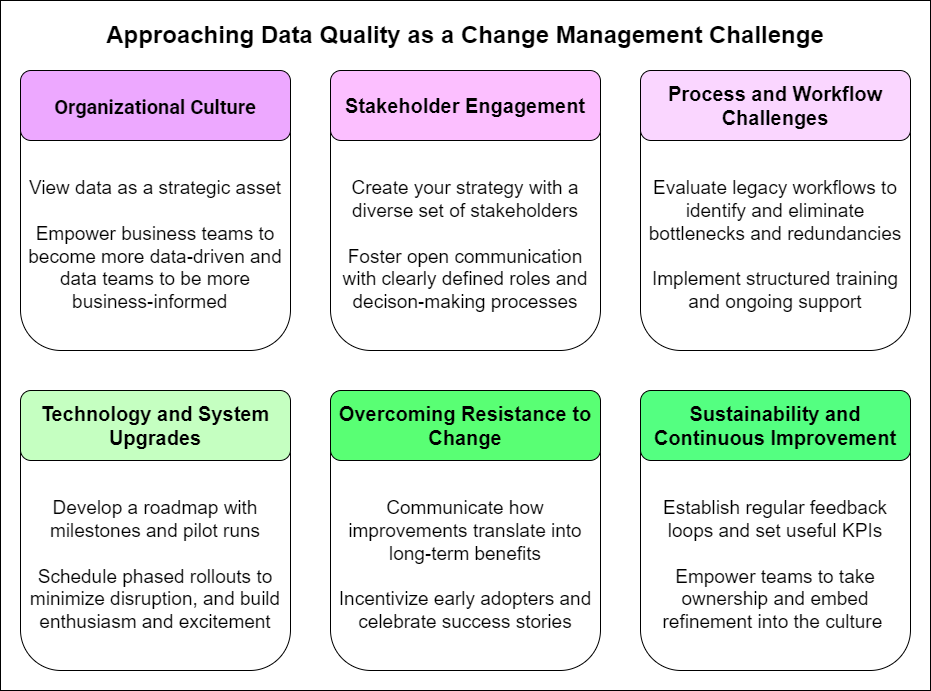
When we look at data quality through the lens of change management, we discover that many of the hurdles we repeatedly face are not about the tools or technologies, but rather about transforming our mindset, our culture and practices. In this article, we explore six dimensions that describe how data quality initiatives overlap with change management. Hopefully, this can change how you think about these problems!
The six dimensions discussed are:
Organizational Culture
Stakeholder Engagement
Process and Workflow Challenges
Technology and System Upgrades
Overcoming Resistance to Change
Sustainability and Continuous Improvement
Organizational Culture
Poor data quality often stem from cultural issues within an organization, even in 2025 data is seen as a byproduct rather than a strategic asset all too often. This mindset filters down from leadership through to team structure and how the organization operates. We all know of siloed business and data teams…
Changing this perception of data is a vital part of the change management process. Giving data teams the opportunity to become more business-informed and business teams the chance to be more data-informed leads to an integrated culture which prioritizes data quality. This is where many organizations go wrong!
When every team member values data as the foundation of good decision making, organizations can level-up their operations and new use-cases open up. As with any cultural shift, this is not instantaneous but requires an ongoing investment into your people and processes, requiring leadership buy-in, and a commitment to treating data as a core asset across the organization.Stakeholder Engagement
Successful data quality initiatives require active participation from a diverse group of stakeholders. This not only includes data engineers and business users but also other roles like data owners, data stewards, and IT teams. Each brings a valuable perspective on how to better utilize data for increased business value.
Effective change management aligns the different stakeholder interests and ensures that each and every stakeholder understands the benefits of improved data quality. Open communication, clear roles and responsibilities, and an emphasis on collaborative decision-making are essential to drive a sustainable approach. When stakeholders are engaged and feel a sense of ownership, change becomes less about enforcement and more about collective progress.Process and Workflow Changes
All too often legacy processes and outdated workflows are negatively affecting data quality. Outdated data collection methods introduce new errors (e.g. as data sources change) and systems which haven’t prioritized data prevent issues from being fixed. Addressing these issues requires thoughtful redesign without completely disruption business operations.
Change management here means identifying the necessary adjustments, making a plan to address them and also preparing teams for the shifts ahead. This involves:Evaluating current workflows: Understand exactly where bottlenecks, redundancies, or errors occur. Think about how data management and governance integrate into each workflow.
Planning and training: Implement well thought out and structured training programs to guide staff through new procedures and ways of working.
Offering continuous support: Ensure there is consistent support and assistance available to help to overcome initial hurdles. This is key for reducing friction and and creating lasting improvements.
By re-engineering (and in some cases re-imagining) processes with change management in mind, organizations can create more robust, error-resistant workflows that continuously contribute to improving data quality standards.
Technology and System Upgrades
Improving data quality may require investing in and implementing new technologies; these may be data cleansing tools, knowledge management software, or advanced analytics platforms. The introduction of new tools, technologies and systems is often met with resistance.
Here, change management reduces the disruption to the organization by managing technology transitions through:Comprehensive planning: Establish a roadmap that outlines timelines, deliverables, and contingency plans. Make sure there are dedicated points of contact, message channels and drop-in sessions to communicate what’s coming up and answer any questions and concerns as they arise.
User acceptance: Get users excited for what’s coming up through demonstrations, pilot runs, closed user-groups, and iterative feedback loops.
Minimizing disruption: Schedule rollouts with lots of lead time and in ways that don’t overwhelm day-to-day operations. Integrate slowly and with purpose so you can manage risk while moving toward your goals.
A successful technology transition has users invested in its success.
Overcoming Resistance to Change
Data quality is an enabling function and not one that explicitly derives value. This can lead to resistance as it’s easily deprioritized in favor of work that has impact now. Data quality is all about the long game and if not motivated, individuals may perceive new processes as extra work or even a threat to their established roles (see the fear mongering of AI, it’s replacing us all tomorrow, right?!).Here, change management strategies focus on people’s mindset:
Understanding the root cause: Actively listen to concerns and identify perceived pain points. You can incorporate these into your rollout strategy!
Communicating benefits: Be intentional in your communication and articulate how the planned changes will positively impact work routines and long-term outcomes. Here, you want to address the fear of the unknown.
Providing incentives: Establish rewards or recognition systems to celebrate early adopters who champion data quality improvements. Your champions are very important to spreading positive experiences. First impressions matter!
By proactively addressing resistance and incentivizing change, organizations can transform concern into enthusiasm, reducing friction and making the transition smoother and more effective.
Sustainability and Continuous Improvement
Data quality is not a one-off project, it’s an ongoing commitment that needs continuous monitoring, feedback, and refinement.
A core pillar of change management is embedding a mindset of continuous improvement into the organization's DNA. This involves:
Regular feedback loops: Create mechanisms for periodic review and adjustment. Prioritize fixing issues early to build and retain trust.
Setting realistic KPIs: Establish metrics that reflect progress and highlights areas needing further investment. Publicize and celebrate progress and milestones as they’re reached to help keep people motivated and engaged.
Cultivating ownership: Empower teams to take initiative and contribute to improvements as part of their everyday roles. Each team is an expert in the workflows they own and with support their contributions maximize progress toward the organization’s overarching data quality goals.
A sustainable data quality initiative is one where improvements are not seen as the finish line but as a step in the organization’s data maturity journey.
Conclusion
Reframing data quality as a change management challenge expands our perspective beyond technical fixes. It shifts our focus to cultural changes, stakeholder dynamics, and process re-engineering to achieve long-term improvement. For best results your steering committee should include a combination of stakeholders from data engineers, business users, IT teams and data governance professionals.
Hopefully, these six dimensions can provide a different perspective on how you think about data quality and help you get that data quality initiative you’ve been thinking about, off the ground!
To receive new posts and support our work, become a free or paid subscriber today.If you enjoyed this newsletter, comment below and share this post with your thoughts.